
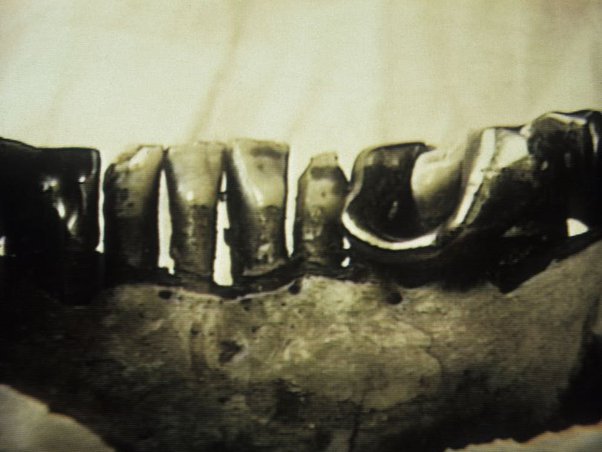
What you see in this picture is a very famous lower row of teeth, that of Adolf Hitler.
Hitler often claimed that he had no fears.
But his dentist Hugo Johannes Blaschke told a different story.
Hugo Blaschke
Doctor Blaschke mentions in his notes and in interviews conducted after the end of World War II that Hitler was very afraid of dentists.
Everyone is a little afraid of dentists, especially as a child, but Hitler was literally afraid for his life when he entered a dentist’s treatment room.
Sometimes it took the dentist up to eight days just to take care of a tooth abscess.
Blaschke was extremely proud to be Hitler’s dentist. But his patient shared none of his feelings.
The “Führer” is even said to have cried before every dental procedure, as Blaschke mentions in his notes.
On the days when he had a dental procedure performed, he did not show his face in public, as this would have tarnished his infallible image.
(Here you can see a little of his teeth).
A dentist wrote in her doctoral thesis about Hitler:
It is very likely that Adolf Hitler had strong bad breath. He ate very poorly and suffered from periodontal disease. In 1944, suppuration was added to his upper jaw, so that a molar tooth had to be removed. Hitler was probably very sensitive to pain. So he afforded himself the luxury of ordering his personal dentist, Johannes Blaschke, to the Reich Chancellery eight times for a root canal treatment, usually done in one or two sessions . .”
The medical records that have been found speculate that his dental filling was made from gold teeth taken from Jews who had been gassed in concentration camps.
Also of interest regarding Hitler’s dental records is the fact that they were very useful in identifying Hitler’s body by his dentition. Thus, it was possible to confirm that he had died in Berlin and had not fled to other parts of the world, as some historians assume.
X-ray image of Hitler
This drawing of Hitler’s dentist Hugo Johannes Blaschke, made after the end of the war, shows the dental status of his most important patient. It matched almost exactly the findings of Nikolai Kraevsky, the chief pathologist of the 1st White Russian Front – who performed an autopsy on Hitler’s body on May 5, 1945.| Public Domain
Hitler’s dental phobia remained a secret between Hitler and Blaschke, as far as medical records go.